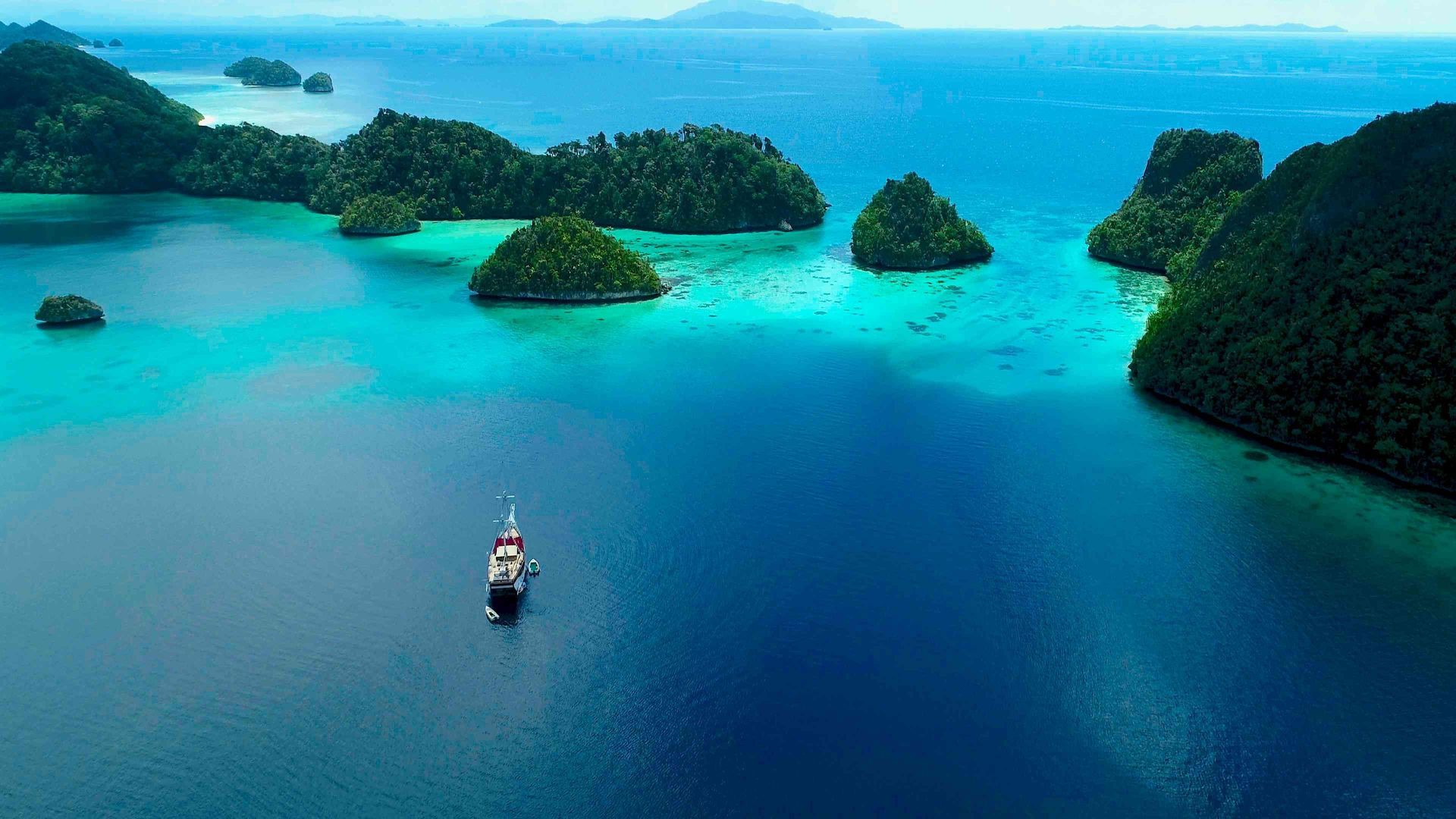
Raja Ampat is the marine biodiversity capital of the world. More coral and fish species per square kilometre than anywhere else on Earth. Endemic species found nowhere else. And reefs that marine biologists describe as some of the last pristine reef systems on the planet — this is what diving in the Coral Triangle's heart actually looks like.
This guide covers everything you need to plan a Raja Ampat liveaboard trip: best seasons, dive regions, getting there, what to expect, and what to budget. It's part of our complete Indonesia liveaboard guide — the central hub for all Indonesian diving destinations. Want a quick overview first? See our Raja Ampat destination page.
Quick Facts About Raja Ampat
- Best season: October–April for calm seas, peak manta activity, and best visibility
- Coral species: 574 species — 95% of Coral Triangle diversity, 72% of world total¹
- Fish species: 1,500+ documented reef fish species⁵
- Water temperature: 27–30°C year-round
- Visibility: 15–30m typical, exceeding 40m at top sites
- Dives per day: 3–4 including night dives on most itineraries
- Who can join: Most boats welcome all guests, diving or not
- Experience level: Open Water minimum, current experience recommended for some sites
- Trip length: 7–14 days recommended
- Cost range: $150–1,200+ per day depending on vessel category
- Gateway airport: Sorong (SOQ) via Jakarta (CGK), Makassar (UPG), or Bali (DPS)
- Booking lead time: 6–12 months for peak season (December–March)
Quick Answers
When is the best time to visit Raja Ampat?
October to April offers the best conditions — calm seas, good visibility, and peak manta ray activity at cleaning stations. December through March is peak season with the highest manta activity. April is shoulder season with good diving and fewer boats. July to September brings stronger trade winds; most operators relocate their vessels, though some stay and focus on central routes.
How much does a Raja Ampat liveaboard cost?
Budget vessels start at $150–300 per day. Mid-range runs $300–600 per day with private or shared cabins, camera rooms, and nitrox. Luxury ranges from $600–1,200+ per day. Most itineraries run 7–14 days — budget for the full trip including Raja Ampat conservation fees. Our liveaboard category guide covers what you get at each level.
Do I need advanced certification for Raja Ampat?
No — Open Water is accepted on most boats. Intermediate experience is recommended since many of Raja Ampat's best sites involve moderate currents. Central routes around Gam Island and the Dampier Strait are beginner-friendly, with sites suitable for all levels alongside more advanced dives.
What marine life will I see in Raja Ampat?
Manta rays at cleaning stations from October through April — both reef and oceanic mantas. Walking sharks (epaulette sharks) and wobbegong sharks endemic to this region. Pygmy seahorses, mandarin fish, ghost pipefish, and hundreds of nudibranch species. Massive schools of barracuda, jacks, and fusiliers around seamounts. Reef sharks at most sites. The density of life at every level is what makes Raja Ampat different — a single dive at Cape Kri can turn up more species than an entire week elsewhere.
Is Raja Ampat suitable for beginners?
Yes — with the right itinerary. Central Raja Ampat routes around Gam Island are well-suited to newer divers, with protected bays and gentle conditions. Most operators run a check dive on day one and adjust site selection accordingly. If it's your first liveaboard, our beginner's guide covers what to expect.
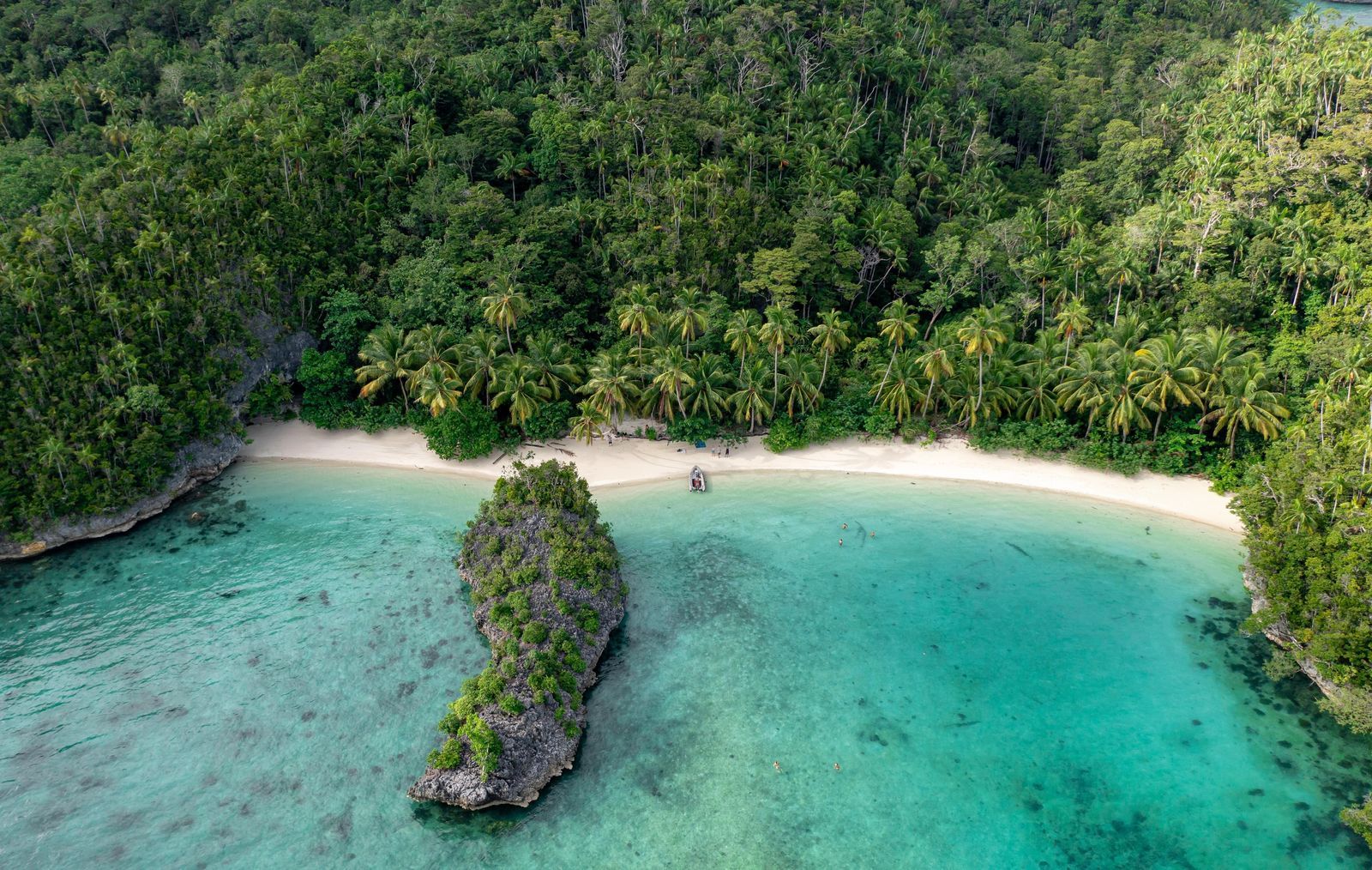
Aerial view of secluded tropical beach with crystal clear waters in Indonesia, accessible by liveaboard diving cruise
Why should you choose Raja Ampat?
Raja Ampat sits at the heart of the Coral Triangle — specifically the Bird's Head Seascape of West Papua⁶, which holds more coral diversity than anywhere else on Earth. The 574 coral species here represent 95% of the entire Coral Triangle's coral diversity and 72% of the world total¹ ². Marine biologist Dr. Gerald Allen recorded 374 fish species on a single dive at Cape Kri in 2012³ — a number that tells you more about what diving here actually feels like than any general description can.
Unlike the volcanic islands to the west of Indonesia — where steep hillsides drop straight into the ocean, cliffs meet the water, and beaches are rare — Raja Ampat is karst limestone. The result is a landscape most people imagine when they think of a tropical paradise: emerald islands rising from flat turquoise water, hidden lagoons, white sand beaches, and endless sheltered bays. Above water and below, it looks like nowhere else in Indonesia.
What keeps the reefs in such extraordinary condition is a combination of geography and protection. The Indonesian Throughflow carries nutrient-rich water through the archipelago. Raja Ampat's relative remoteness has kept fishing pressure low. And in 2007 the Indonesian government declared a network of Marine Protected Areas covering 1.2 million hectares⁴, with local communities actively involved in conservation from the start — Raja Ampat is a global model for how marine tourism and protection can work together.
Wondering how Raja Ampat compares to other destinations? Our why choose Indonesia guide covers the full picture.
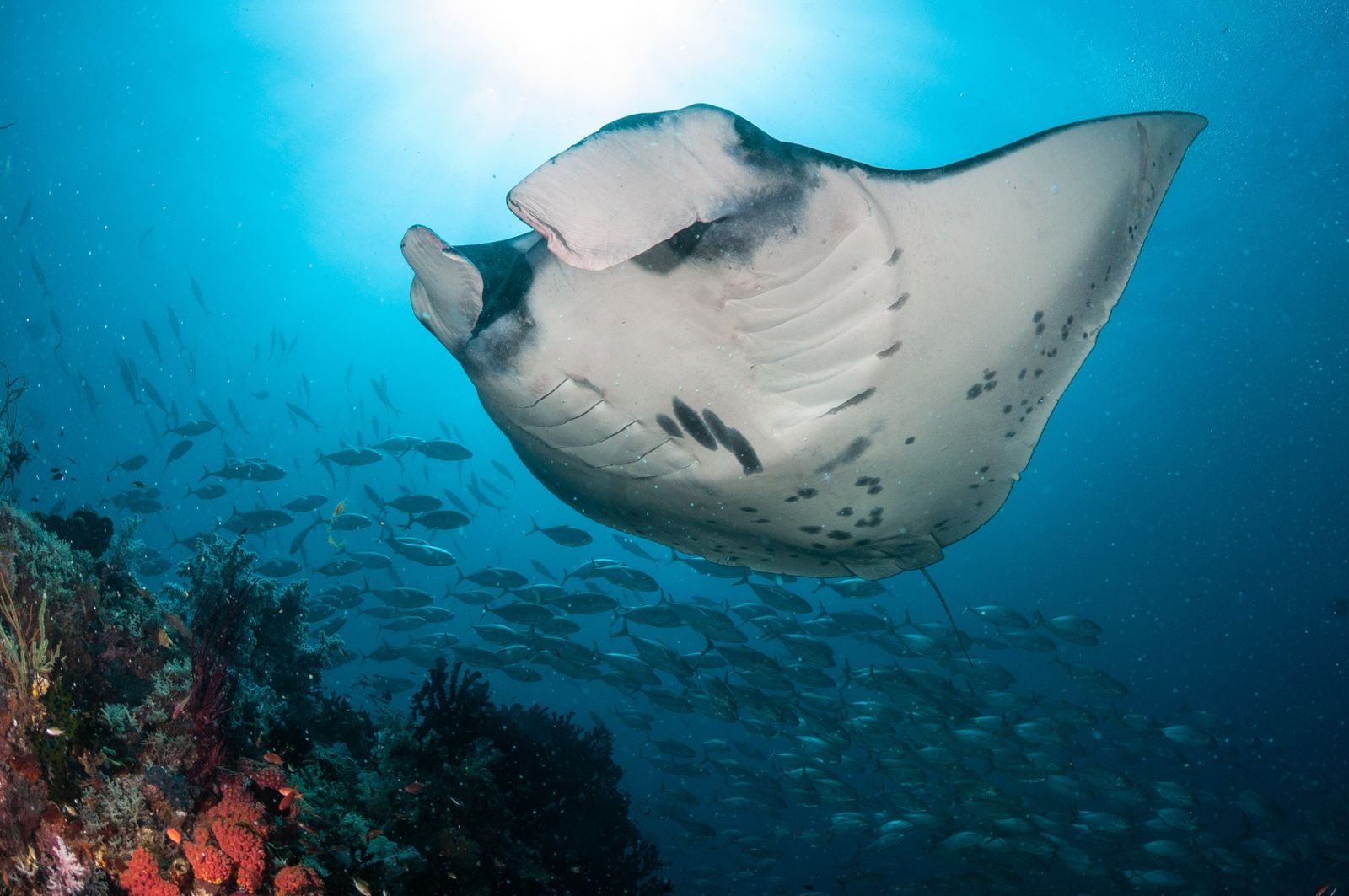
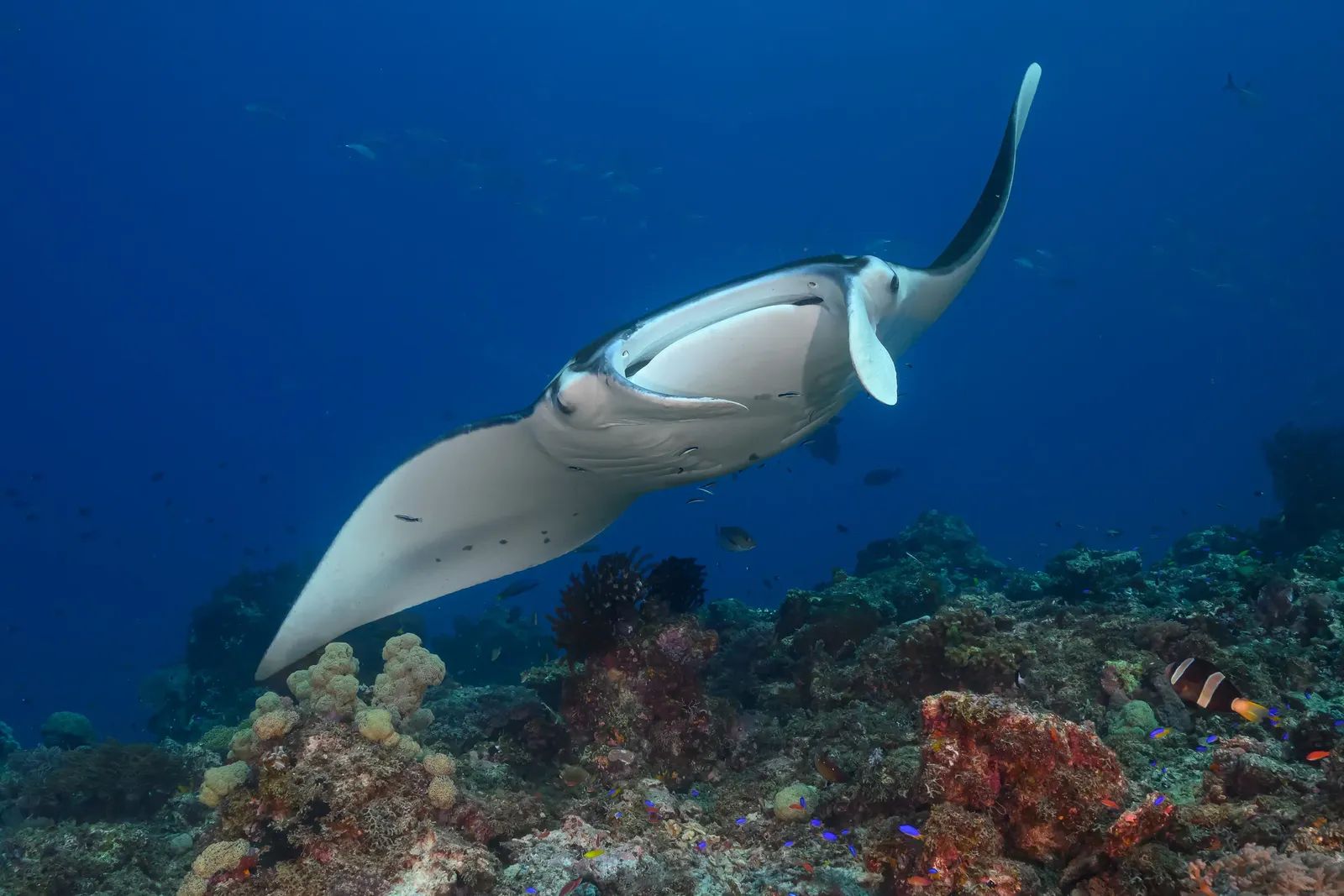
Giant manta ray close-up underwater photograph Raja Ampat diving Indonesia liveaboard destination - Picture by Dewi Nusantara
Best Time to Visit Raja Ampat
October–April is the main liveaboard season. Seas are calm, visibility peaks, and manta ray activity at cleaning stations like Manta Sandy and Manta Ridge is at its best. December through March is peak season — book 6–12 months ahead for this window.
May–June is a transitional shoulder period. Conditions are variable, some operators have reduced schedules, and crowds thin out. Decent diving with potential for last-minute availability.
July–September brings the southeast trade winds. Seas can get rough, particularly in southern areas like Misool. Most liveaboards relocate to Komodo or other Indonesian destinations during this period. Some operators stay and run Central Raja Ampat and Dampier Strait itineraries — conditions can still be excellent in sheltered sites, but unsettled weather is common. If you travel in this window, go in with flexible expectations.
For full month-by-month detail, see our Indonesia seasonal patterns guide.
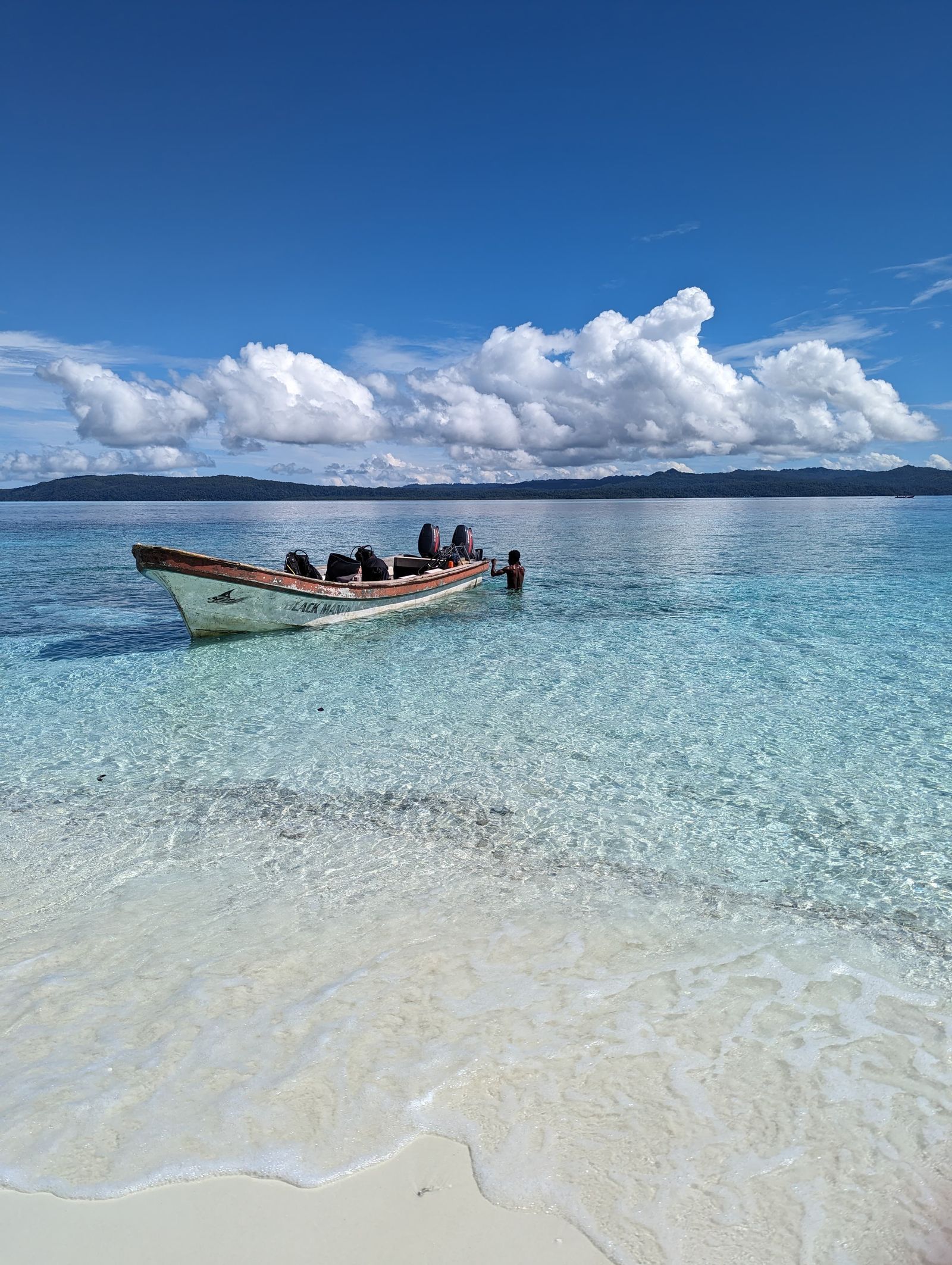
Local Boat in calm crystal clear seas of Raja Ampat. Perfect for diving and liveaboard expeditions - Picture by Tina Bogdanova
Getting There
Gateway: Sorong Airport (SOQ) is the main departure point for Raja Ampat liveaboards. Most international travellers route through Jakarta (CGK) or Bali (DPS) with domestic connections.
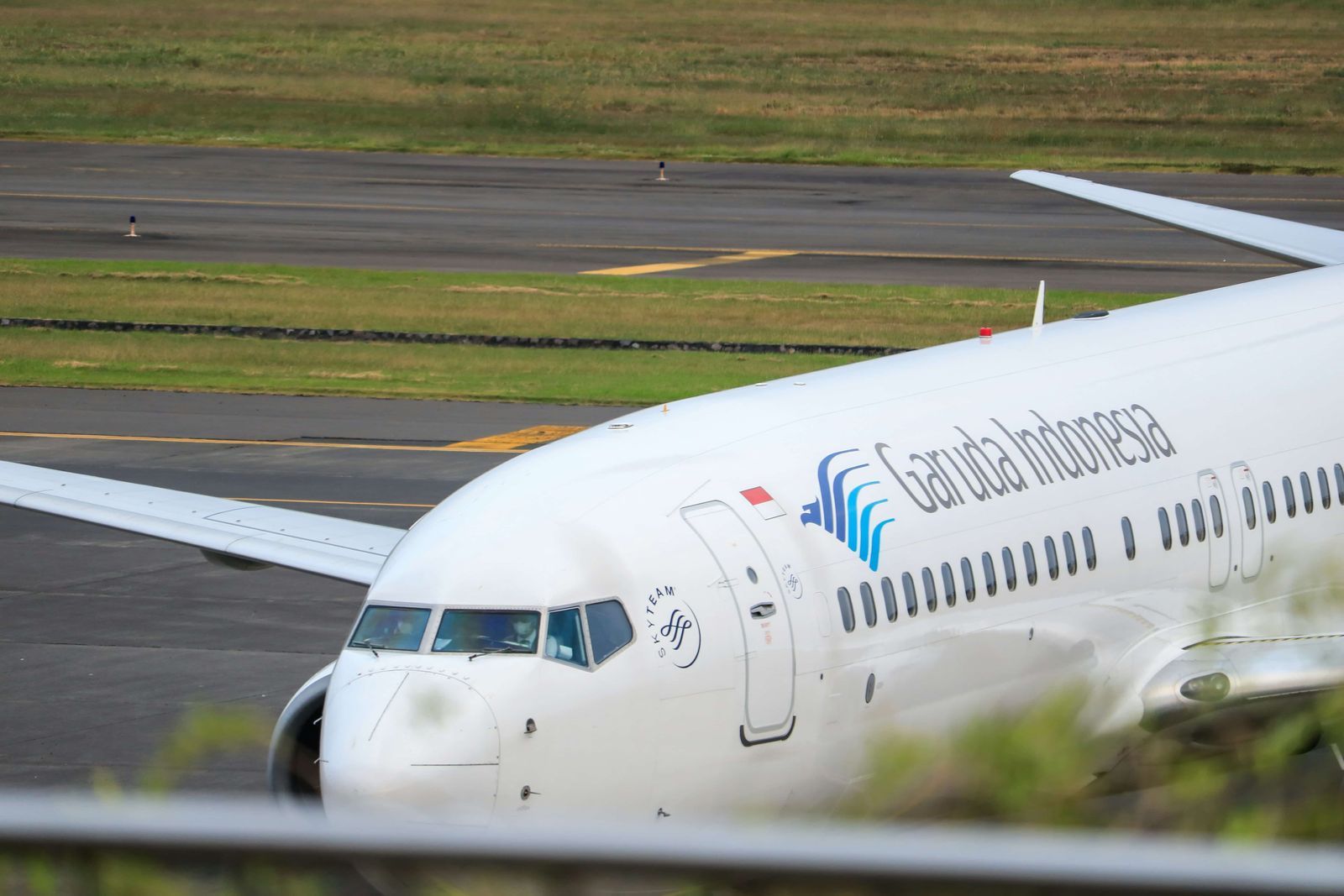
Dari Jakarta: Penerbangan langsung harian ke Sorong dengan Garuda Indonesia, Batik Air, dan Nam Air. Waktu penerbangan sekitar 4,5–5 jam. Rute paling andal.
Dari Bali: Penerbangan langsung ke Sorong muncul di beberapa jadwal tetapi sering dialihkan melalui Jakarta karena muatan yang tidak mencukupi — secara efektif menjadikannya satu perhentian yang panjang. Rencanakan koneksi Jakarta daripada mengandalkan layanan langsung Bali–Sorong, dan Anda akan menghindari kejutan yang tidak menyenangkan.
Buffer kedatangan: Tiba di Sorong setidaknya satu malam sebelum keberangkatan liveaboard Anda. Penundaan penerbangan domestik di rute terpencil adalah hal biasa. Kami menyertakan satu malam di Swiss-Belhotel Sorong sebagai hadiah pemesanan, yang menempatkan Anda dekat dengan pelabuhan dan menghilangkan satu kerumitan logistik dari pundak Anda.
Perjalanan ke Raja Ampat dari Sorong: Sebagian besar liveaboard — mayoritas kapal layar kayu phinisi tradisional yang dibangun oleh komunitas Bugis di Sulawesi Selatan — berangkat langsung dari pelabuhan Sorong. Feri umum juga berjalan dari Sorong ke Waisai (ibu kota Raja Ampat) dan memakan waktu sekitar dua jam, berguna bagi mereka yang tiba secara mandiri atau memperpanjang masa tinggal mereka di sebuah resor.
Pelabuhan alternatif: Beberapa rencana perjalanan menggunakan Waisai atau Kaimana sebagai titik keberangkatan atau kedatangan tergantung pada operator dan rute. Logistik transfer Anda tergantung pada kapal spesifik Anda — konfirmasikan dengan kami saat memesan.
Jaringan penerbangan domestik Indonesia membutuhkan pengetahuan lokal — jadwal berubah, situs web maskapai seringkali tidak menerima kartu asing, dan gangguan menit terakhir adalah bagian dari kenyataan. Kami mengoordinasikan penerbangan domestik melalui VIFA Holiday — DMC terkemuka untuk industri penyelaman Indonesia — yang memantau pemesanan Anda secara real-time dan memesan ulang segera jika terjadi kesalahan.
Garuda Indonesia aircraft runway Indonesian domestic flights liveaboard transfers
Perjalanan ke Raja Ampat
Wilayah Penyelaman Raja Ampat
Raja Ampat terbagi menjadi tiga wilayah penyelaman utama, masing-masing dengan karakter yang berbeda. Ini adalah area yang luas secara geografis — transit semalam antar wilayah adalah hal biasa, dan penyeberangan bisa bergelombang. Ini adalah penyelaman liveaboard gaya ekspedisi, bukan perjalanan resor.
Northern Raja Ampat — Wayag and Kawe
The most remote and dramatic region, featuring the iconic mushroom-shaped karst islands. Fewer liveaboards reach here, making it genuinely crowd-free. Sites like Bird Wall, Black Rock, and Eagle Rock offer spectacular diving, and the Wayag Ranger Station jetty is famous for blacktip sharks patrolling the shallows. Best suited to advanced divers comfortable with remote locations and changeable conditions.
Typical sites: Black Rock, Eagle Rock, Wayag Lagoon.
Central Raja Ampat — Dampier Strait
The most accessible region and the highest concentration of dive sites in the archipelago. Cape Kri holds the world record for fish species counted in a single dive — 374 species in 90 minutes, recorded by Dr. Gerald Allen in 2012³. Blue Magic, a submerged seamount north of Kri Island, is where oceanic manta rays appear regularly, sweeping in from the blue on strong current days. This is where most 7-day itineraries focus, and where beginners and advanced divers alike find the best of Raja Ampat in one region.
Typical sites: Cape Kri, Chicken Reef, Blue Magic, Sawandarek Jetty, Arborek Jetty.
Southern Raja Ampat — Misool
One of the most significant marine conservation success stories in Southeast Asia — and a model now being replicated elsewhere in the world. In 2005, the waters around Misool were being devastated by rampant shark finning, reef bombing, and destructive fishing. That year, Misool Resort partnered with local communities to lease the sea and reefs directly from the villages and establish the region's first No-Take Zone. The Misool Foundation⁷ now manages a 300,000-acre marine reserve patrolled 24 hours a day by 18 local rangers operating from three stations. The results are measurable: fish biomass inside the reserve increased by 248% between 2007 and 2021, shark numbers increased by 190% since 2012, and the local manta sub-population has doubled over ten years⁷.
La bióloga marina Dra. Mark Erdmann describe Misool como "uno de los sistemas de arrecifes más prístinos que quedan en la Tierra, uno de los pocos lugares en el universo donde la biodiversidad está mejorando en lugar de disminuir".⁷
El buceo lo refleja. El crecimiento de coral blando es excepcional, las estaciones de limpieza atraen mantarrayas regularmente y Boo Windows es uno de los pasos de natación más fotogénicos del archipiélago. La mejor temporada es de noviembre a marzo, cuando el oleaje estacional disminuye. Los operadores toman decisiones de seguridad primero al cruzar a Misool: la flexibilidad y la confianza en su capitán son importantes.
Sitios típicos: Magic Mountain, Boo Windows, Wedding Cake, Fiabacet.
Vida Marina
Mantarrayas son el encuentro principal de octubre a abril. Las mantarrayas de arrecife residen durante todo el año en estaciones de limpieza como Manta Sandy y Manta Ridge. Las mantarrayas oceánicas aparecen en Blue Magic en días de fuerte corriente. Para obtener información completa sobre los encuentros con mantarrayas en Indonesia, consulte nuestra guía de mantarrayas.
Tiburones — varias especies habitan Raja Ampat. Los tiburones caminantes (tiburones epauleta) son endémicos de esta región, se encuentran en áreas de arrecifes poco profundos y son un favorito para los fotógrafos submarinos. Los tiburones alfombra son comunes, bien camuflados en el fondo del arrecife. Los tiburones de arrecife de punta negra y punta blanca están presentes en la mayoría de los sitios. Los tiburones grises patrullan sitios barridos por la corriente como Blue Magic y Cape Kri.
Vida macro es extraordinaria. Raja Ampat alberga especies endémicas de caballitos de mar pigmeos que no se encuentran en ningún otro lugar. Pez mandarín, pez fantasma, pez fantasma ornamentado, pez sapo y cientos de especies de nudibranquios. Para buceo centrado en criaturas, consulte nuestra guía de animales pequeños de Indonesia.
Peces en cardumen — enormes agregaciones de barracudas, jureles, fusileros y pargos crean muros vivientes alrededor de montes submarinos y pináculos en todo el Estrecho de Dampier.
Para una cobertura más amplia de la vida marina indonesia, consulte nuestra guía de animales grandes de Indonesia.
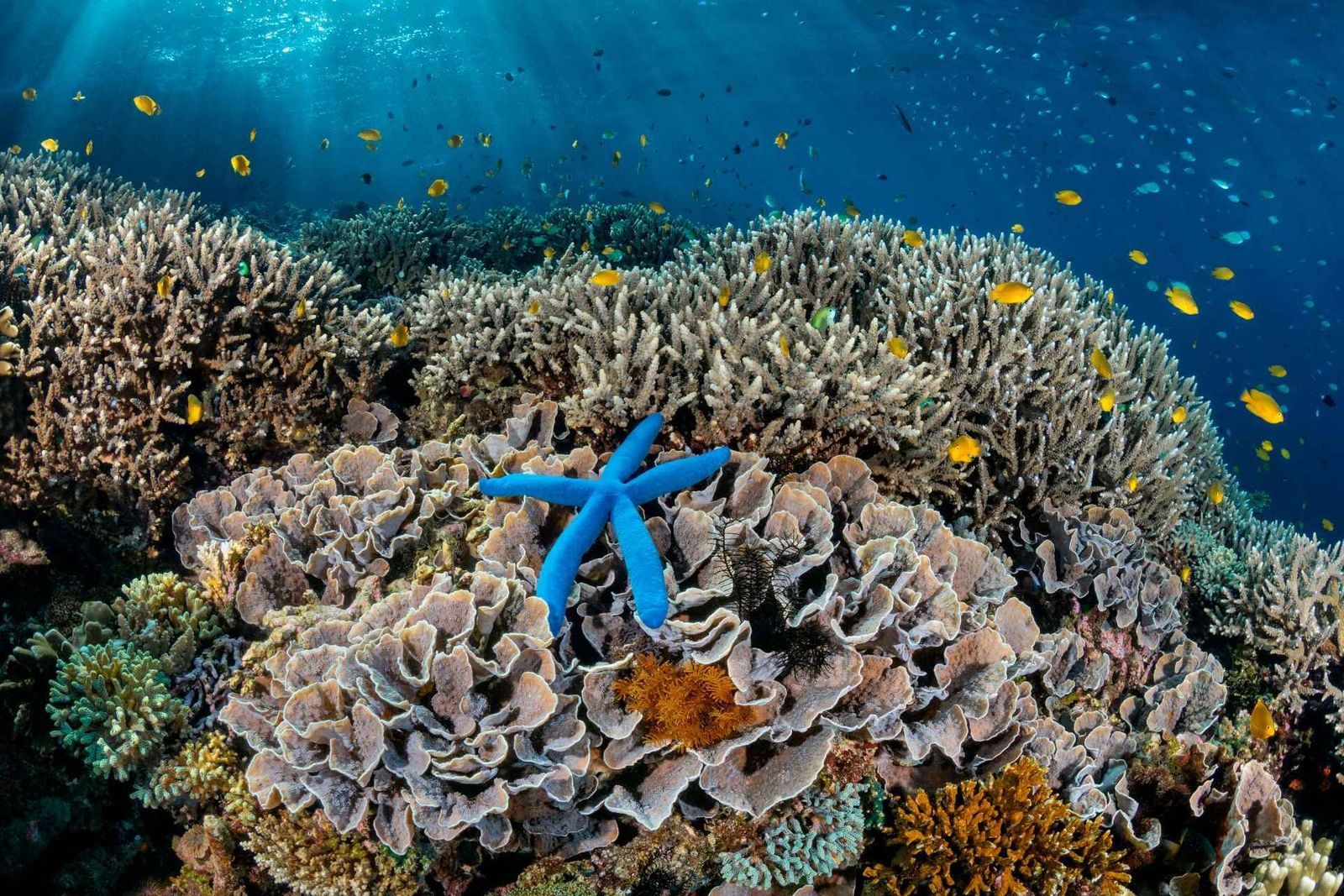
Diverse coral reef ecosystem with blue sea star and yellow fish in Indonesian waters, liveaboard diving - Picture by Majik Liveaboard
Above Water
Raja Ampat liveaboard itineraries typically include land excursions between dives.
Arborek Village — famous for its traditional handicrafts and women's weaving cooperative, a well-run example of community-based tourism that directly benefits local families.
Sawinggrai Village — bird watching for Red Birds of Paradise and other endemic species, best in early morning.
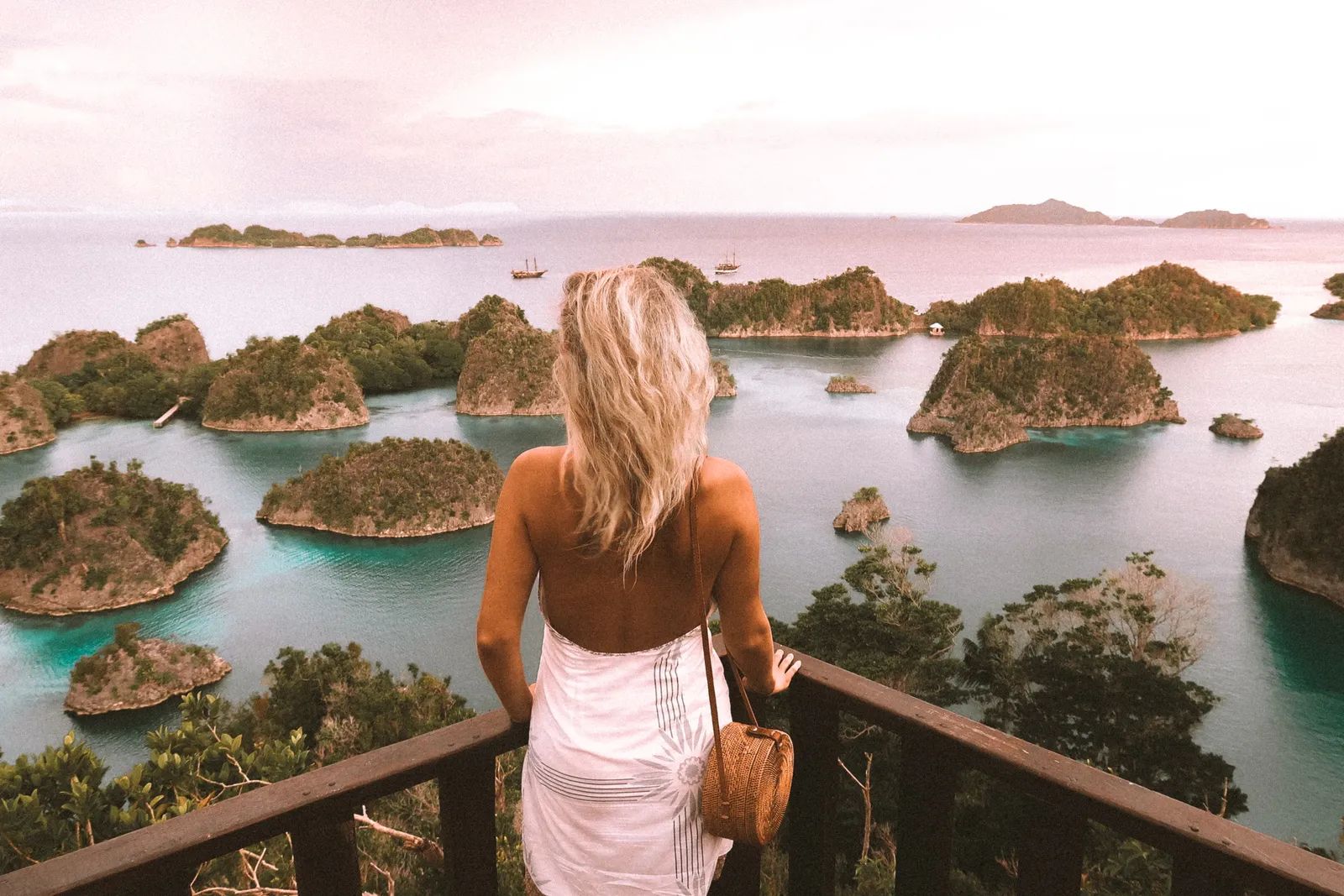
Piaynemo viewpoint — a short but steep climb rewarded with one of the most photographed views in Indonesia: mushroom islands and turquoise lagoons from above.
Kali Biru (Blue River) — a striking blue freshwater river on Waigeo Island, included by many operators as an excursion and a genuinely unusual experience between dives.
Aljui Bay pearl farm — a working South Sea pearl farm, often visited on northern itineraries.
Hidden lagoons — kayaking and swimming in secluded lagoons surrounded by karst limestone. A good way to spend a surface interval.
Panoramic sunrise view over famous Pianemo lagoon with mushroom-shaped limestone islands and traditional boats in Raja Ampat - Picture by Calico Jack Cruises
Managing Expectations
Raja Ampat is a big place. The archipelago spans over 50,000 km² — overnight transits between regions are normal, and crossings from Sorong to Misool in particular take time and can be bumpy and noisy with the engine running. This is expedition-style diving.
Currents are real. Sites like Cape Kri and Chicken Reef have significant current. Most Central Raja Ampat sites are manageable with basic experience — your dive guide will brief you and assess conditions before each dive.
Visibility varies. Plankton blooms during manta season can reduce visibility significantly. The trade-off is that the mantas are there because of the plankton. Misool typically has the clearest water.
Manta rays aren't guaranteed. October through April gives you the best odds anywhere in Indonesia. Most divers on a 7-day central itinerary see mantas — but most isn't all.
Misool requires calm conditions. Southern itineraries can be affected by swell, particularly early and late season. Operators make safety-first decisions on whether to cross.
Remote means remote. Raja Ampat is not close to major medical facilities. Comprehensive dive insurance with medical evacuation coverage is mandatory in Indonesia and required by operators. DAN coverage is widely recommended.
Build in a buffer night in Sorong. Domestic flight delays happen regularly — arriving the day of your liveaboard departure is a real risk. We include a night at the Swiss-Belhotel Sorong as a booking gift, which puts you close to the harbour and takes one logistics headache off your plate.
Reef manta ray on a cleaing station in Indonesia - Picture by Neptune Liveaboards
Frequently Asked Questions About Raja Ampat
¿Con cuánta antelación debo reservar?
Para temporada alta (diciembre-marzo), con 6-12 meses de antelación. Los barcos populares en fechas clave se llenan pronto, especialmente alrededor de Navidad y Año Nuevo. Para temporada media (octubre-noviembre y abril), se necesitan 3-6 meses. Ocasionalmente aparece disponibilidad de última hora; consúltenos si sus fechas son flexibles.
¿Cuáles son las tasas de conservación de Raja Ampat?
Hay dos tasas separadas: el PIN del Parque Marino de Raja Ampat (una etiqueta de conservación anual) y un Ticket de Entrada para Visitantes introducido en 2019 para apoyar la infraestructura turística local. También hay una tasa de entrada para embarcaciones basada en el tamaño del barco, que la mayoría de los operadores incluyen en el precio del viaje. El desglose completo lo explica la Asociación de Alojamientos de Raja Ampat⁹. Confirme con su operador qué está incluido y qué no antes de reservar.
¿Cómo funcionan las reservas de camarotes en los cruceros de Raja Ampat?
La mayoría de los barcos venden camarotes de forma compartida: usted reserva una plaza y el operador empareja a viajeros del mismo sexo si no se ocupan ambas camas en la misma reserva. Si desea privacidad garantizada, compruebe si el barco tiene camarotes individuales dedicados (más raros, a veces sin suplemento) o pague el suplemento individual para tener un camarote doble o de dos camas para usted solo. Ocasionalmente, la segunda plaza queda sin vender y usted obtiene un camarote privado al precio compartido, pero esto no se puede garantizar.
¿Pueden los no buceadores unirse a un crucero de Raja Ampat?
Sí. El snorkel en Raja Ampat es de clase mundial: los arrecifes son lo suficientemente poco profundos como para que los que hacen snorkel en la superficie vean una cantidad extraordinaria. La mayoría de los barcos también ofrecen kayak, visitas a pueblos y caminatas a miradores. Algunos barcos están más preparados para grupos mixtos que otros; consúltenos y le pondremos en contacto con el adecuado.
¿Qué incluye el precio de los cruceros?
Generalmente: alojamiento, todas las comidas, inmersiones guiadas, tanques y traslados en la mayoría de los barcos de gama media y de lujo. Las excursiones en tierra y las visitas a pueblos suelen estar incluidas. No siempre incluidas: nitrox, tasas de conservación, alquiler de equipo y propinas para la tripulación (10-15% es lo habitual). Confirme siempre el desglose completo antes de reservar.
Is nitrox available on liveaboards in Raja Ampat?
Yes, most mid-range and luxury boats include nitrox or offer it at low cost. Budget boats vary. With 3–4 dives daily, nitrox certification is worth getting before your trip.
What should I pack for Raja Ampat?
A 3mm wetsuit is sufficient for most of the season. Comfortable closed shoes are worth bringing — the Piaynemo viewpoint and Kali Biru hikes involve uneven terrain. Reef-safe sunscreen is important and increasingly required at conservation sites. A backup mask is worth packing since Sorong's dive shops are limited. Our Indonesia packing guide covers the full list.
Do I need a visa for Indonesia?
Most nationalities pay for a Visa on Arrival, which can be processed at the airport or in advance through Indonesia's official e-visa portal. Use the official portal only — there are third-party services that charge inflated fees. Ensure your passport has at least 6 months validity remaining.
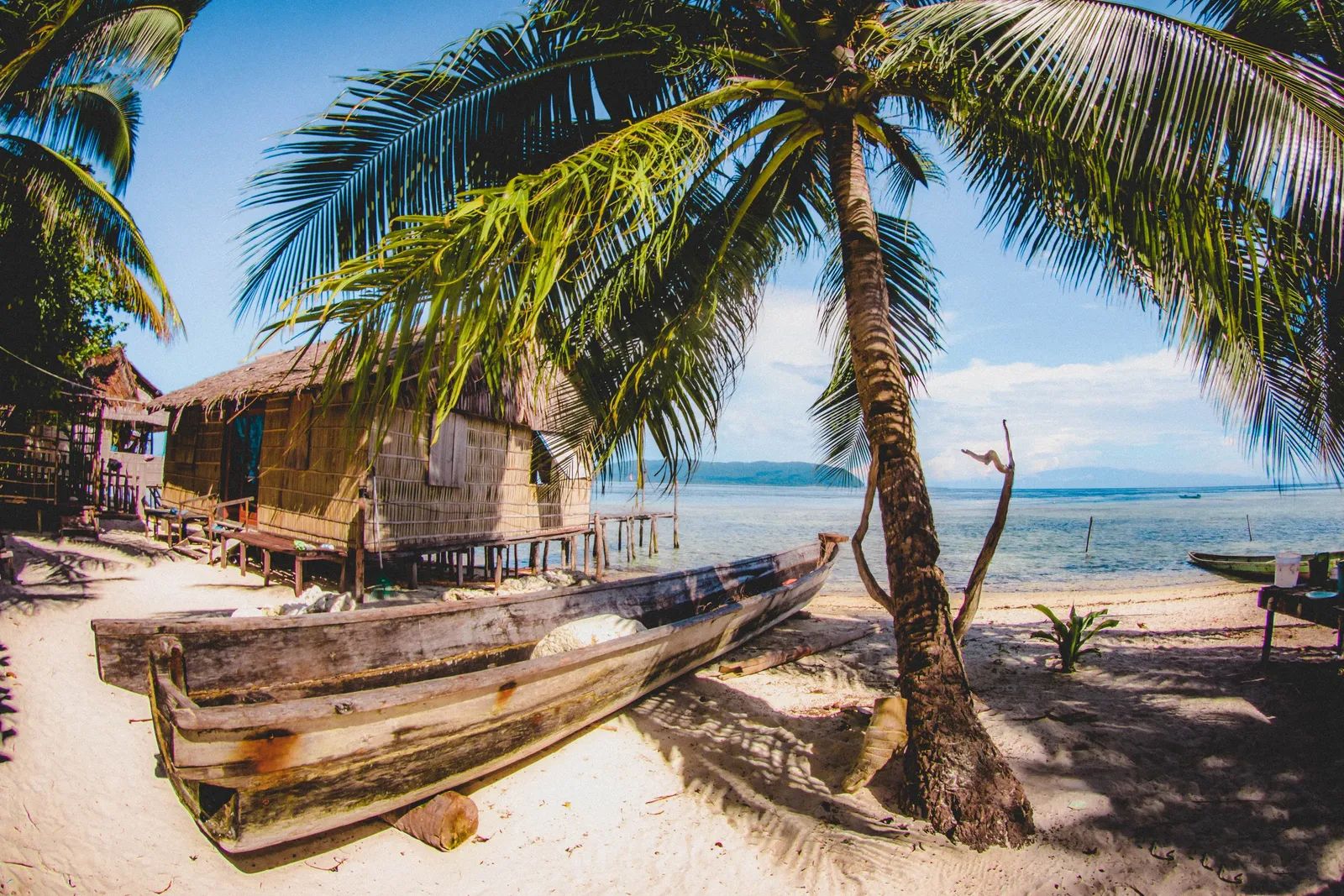
Traditional Indonesian village with thatched roof houses on stilts and coconut palms on pristine beach in Raja Ampat - Picture by Calico Jack Cruises
Ready to Book Your Raja Ampat Liveaboard?
We're a Bali-based platform run by divers who know Raja Ampat well. You'll pay the same price booking through us as booking direct — operators maintain price parity across all channels. What you get on top is real support: domestic flight coordination through VIFA Holiday, a booking gift including a night at the Swiss-Belhotel Sorong, and a team that genuinely wants your trip to go well.
Questions before you book? Message us on WhatsApp or reach us via our contact form. Want to know more about how we work? Read our why book with Coralbound page.