Indonesia holds the largest documented manta ray populations in the world — and unlike most destinations, encounters here are built on resident populations, not seasonal migrations.
This guide covers where and when to find manta rays across Indonesia, what makes each site different, and what to expect on the water. It's part of Coralbound's Indonesia liveaboard guide; our big animal diving guide covers the full megafauna picture and why divers choose Indonesia covers the broader case for the country. For a quick destination overview, see the Komodo destination page or the Raja Ampat destination page.
Indonesia hosts both reef manta rays (Mobula alfredi) and oceanic manta rays (Mobula birostris). Reef mantas — three to five metres wingspan — form the resident populations at cleaning stations throughout the archipelago. Oceanic mantas, larger at five to seven metres, are pelagic and less predictable, but reliably encountered at specific sites in Raja Ampat and Komodo during the right season. Reef mantas are classified as Vulnerable on the IUCN Red List²; oceanic mantas have been uplisted to Endangered⁹.
Quick Facts
- Best season: year-round at Komodo and Nusa Penida; October–April peak in Raja Ampat; March–June at Sangalaki
- Water temperature: 26–29°C across main manta sites; can drop sharply at Nusa Penida and southern Komodo during upwelling
- Visibility: 15–30m at cleaning stations; reduced at plankton-rich feeding sites
- Experience level: Open Water minimum; most cleaning stations suitable for beginners and snorkellers
- Trip length: 7–10 days Komodo-focused; 8–14 days Raja Ampat; day trips from Bali for Nusa Penida; 7–12 days for Sangalaki/Derawan
- Who can join: divers and snorkellers; cleaning stations typically 8–15m, surface feeding accessible from above
- Cost range: $300–600/day mid-range; $600–1,000+/day luxury
- Key species: reef manta (Mobula alfredi, IUCN Vulnerable); oceanic manta (Mobula birostris, IUCN Endangered)
- Gateway airports: Labuan Bajo (LBJ) for Komodo; Sorong (SOQ) for Raja Ampat; Ngurah Rai (DPS) for Nusa Penida; Berau/Kalimarau (BEJ) for Sangalaki
- Booking lead time: 3–6 months; 6–12 months for peak Raja Ampat season (December–March)
Quick Answers
Where is the best place to see manta rays in Indonesia?
Komodo National Park is Indonesia's most reliable manta ray destination. A five-year study identified 1,085 individual reef mantas using the park's cleaning stations, with mantas present year-round¹. Raja Ampat is the destination for oceanic mantas — Blue Magic in the Dampier Strait is the primary site, best October–April when plankton-rich currents concentrate both species. Nusa Penida near Bali offers year-round encounters with the least logistical complexity, and Sangalaki in the Derawan Islands has 155 documented individual reef mantas at its cleaning stations⁵.
What is the difference between reef and oceanic manta rays?
Reef mantas (Mobula alfredi) have a wingspan of three to five metres and form resident populations at cleaning stations throughout Indonesia — these are the mantas at Komodo, Nusa Penida, and Sangalaki. Oceanic mantas (Mobula birostris) reach five to seven metres and are pelagic, appearing seasonally at sites like Blue Magic in Raja Ampat and Manta Alley in Komodo. Both are IUCN-listed threatened species — reef mantas as Vulnerable², oceanic mantas as Endangered⁹. Despite the common name, manta rays are not stingrays — they evolved from stingray ancestors and largely lost the stinger through evolution; reef mantas have none at all, while oceanic mantas retain only a vestigial harmless spine⁸.
Can beginners and snorkellers see manta rays in Indonesia?
Yes, although some dive sites require stronger buoyancy control in current. Most manta cleaning stations are eight to fifteen metres deep, accessible to Open Water divers. Snorkellers see equally good encounters when mantas feed at the surface — Manta Sandy in Raja Ampat and the cleaning stations at Komodo both offer reliable surface feeding. Nusa Penida is particularly accessible and makes a natural Bali extension without needing a liveaboard.
When is the best time to see manta rays in Indonesia?
Komodo and Nusa Penida offer year-round encounters; April–November is generally favoured for surface conditions in Komodo. Raja Ampat's peak manta season runs October–April, with December–March the most productive months at Dampier Strait and Misool. Sangalaki peaks March–June. Our Indonesia weather guide covers seasonal conditions across all destinations.
Can I see manta rays and whale sharks on the same trip?
Yes. The Komodo to Sumbawa liveaboard route combines manta rays in Komodo with whale sharks at Saleh Bay (May–September). Raja Ampat combined with Triton Bay offers both species (October–April). For a dedicated whale shark focus, our whale shark guide covers the full picture.
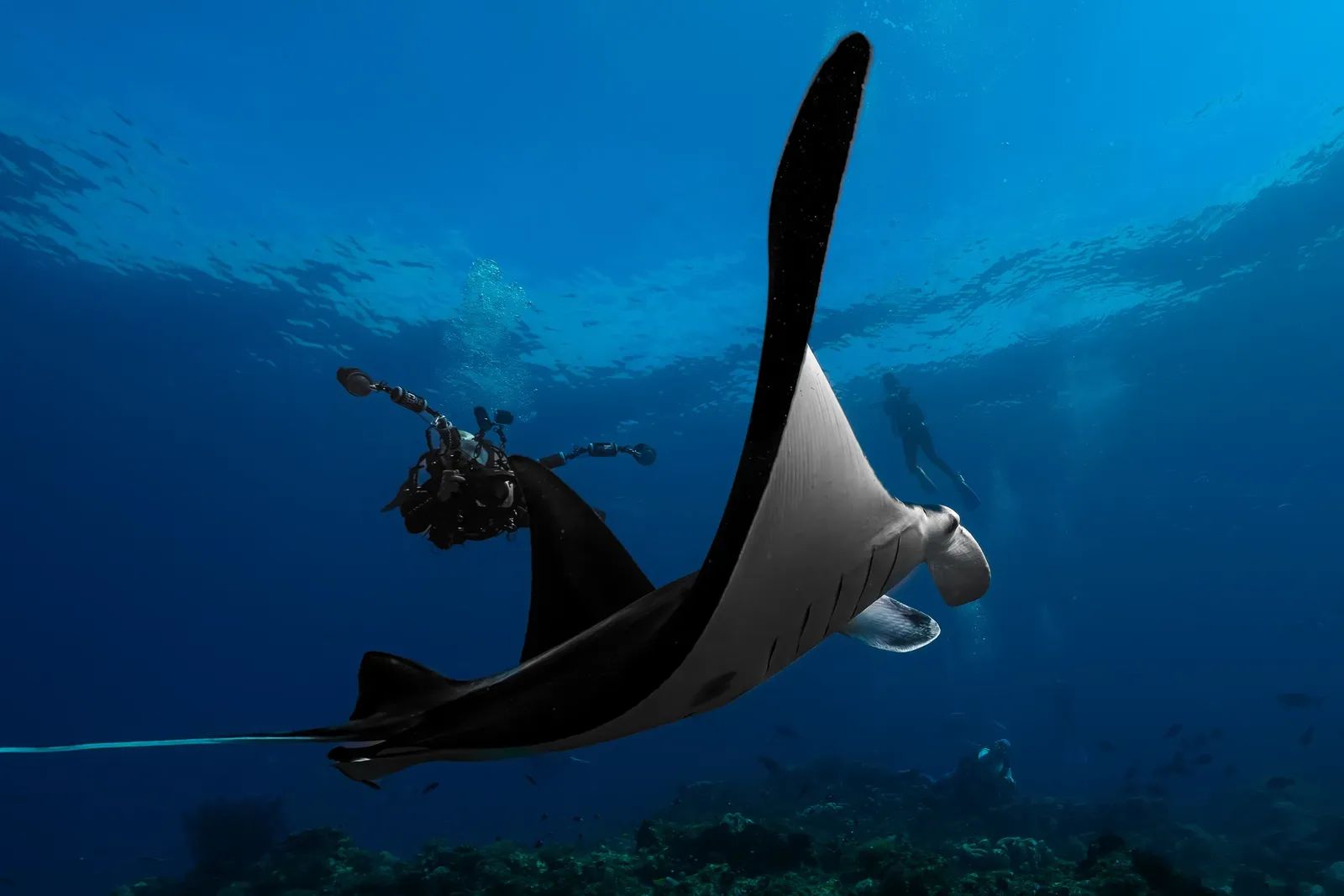
Elegant manta ray with distinctive black and white coloration gliding through blue water with scuba diver - Picture by Neptune Liveaboards
Where to Find Manta Rays in Indonesia
Komodo National Park
Komodo is one of the world's most reliable manta ray destinations. A five-year collaborative study between the Marine Megafauna Foundation and Murdoch University identified 1,085 individual reef mantas across four key sites within the park — and the researchers note the true population is likely higher¹. Mantas are present year-round, with April–November offering the most consistent surface conditions at the main sites.
The four sites are Manta Point (Karang Makassar) and Mawan in the central area, Manta Alley in the remote south, and Cauldron to the north¹. Each attracts different demographic groups — Manta Alley has the highest resighting rates, suggesting the most strongly resident individuals; Cauldron sees more immature mantas. Most liveaboard itineraries visit multiple sites.
Cleaning station encounters at eight to fifteen metres are the core experience. Mantas hover above coral structures while cleaner fish remove parasites, circling repeatedly and often approaching within metres of divers. Snorkellers see the same behaviour from the surface during plankton feeding. The intelligence of these animals is part of what makes the encounter distinctive — manta rays have the highest brain-to-body mass ratio of any fish⁸, and their curiosity toward divers is a genuine behavioural trait, not habituation.
Komodo departures run from Labuan Bajo; some operators depart from Bali on longer routes. For full destination detail, read our Komodo guide or see the Komodo destination page.
Raja Ampat
Raja Ampat offers the best oceanic manta encounters in Indonesia and some of the most productive reef manta cleaning stations in the region. The two species occupy distinct niches: reef mantas at Manta Sandy and Manta Ridge in the Dampier Strait, oceanic mantas at Blue Magic and Magic Mountain in Misool.
Blue Magic is a submerged pinnacle in the central Dampier Strait where strong currents concentrate pelagic life. Oceanic manta encounters here are seasonal — best October–April, peaking December–March when plankton blooms are richest. This is an intermediate to advanced site due to current; solid buoyancy control is needed. Manta Sandy is a shallower cleaning station accessible to Open Water divers and snorkellers, with encounters most reliable in the same October–April window but possible year-round.
The Misool region adds the conservation story that sets Raja Ampat apart. A former shark finning camp was converted into a 300,000-acre no-take marine reserve by the Misool Foundation; since protection began, the reef manta sub-population within the reserve has doubled, and oceanic manta sightings inside the reserve increased 25-fold between 2010 and 2016³. This is documented recovery within a human timescale, visible on every dive in the density and confidence of the animals.
For full destination detail including conservation fees and logistics, see our Raja Ampat guide or the Raja Ampat destination page.
Nusa Penida (Bali)
Nusa Penida is Indonesia's most accessible manta ray destination. The Nusa Penida MPA, declared in 2010 across 20,057 hectares, has 624 individual reef mantas recorded with 5,913 sightings documented⁴. Encounters are year-round, driven by consistent Indian Ocean upwelling rather than strict seasonality.
The main sites sit along the southern and southwestern coast where the current is richest. Both are subject to surge and cold upwelling water, particularly July–September when the southern winter strengthens the Indian Ocean swell. Water temperatures can drop sharply in the thermocline — a five-millimetre wetsuit is worth packing for this period.
Nusa Penida doesn't require a liveaboard. Day trips from Bali or Sanur are straightforward and make it a natural add-on to any Bali-based trip or post-liveaboard extension. Our Bali guide covers the logistics, and our liveaboard extensions guide covers how to fold it into a broader Indonesia trip.
Sangalaki (Derawan Islands)
Sangalaki Island in East Kalimantan (Borneo) hosts a well-documented resident reef manta population. The Marine Megafauna Foundation identified 155 individual reef mantas from 846 encounters at Sangalaki⁵, confirming the high site fidelity these animals show to specific cleaning stations. Peak season is March–June; encounters are possible year-round.
Sangalaki combines naturally with the broader Derawan Islands experience — green turtle nesting beaches, the Kakaban jellyfish lake, and whale sharks at Talisayan bagans. The Derawan Islands are not yet on the main liveaboard circuit; only a handful of operators run there, but they book quickly. For full destination detail, see our Derawan Islands guide.
Other Manta Populations
Indonesia is vast, remote, and still being explored — new manta populations are documented regularly. Liveaboard routes through the Banda Sea regularly encounter reef mantas at cleaning stations, particularly in the Banda Islands and Forgotten Islands sections. Alor and Halmahera both hold manta populations that intersect naturally with the dive sites on those itineraries. The waters between Lombok and Sumbawa are one area where new aggregations have been observed in recent years, with the Marine Megafauna Foundation now researching this corridor. These encounters are genuine but incidental — you wouldn't plan a dedicated manta trip around any of these areas, but they add to the picture of why Indonesia produces more manta encounters per trip than anywhere else on Earth.
Conservation Context
Both manta species are threatened — reef mantas Vulnerable², oceanic mantas Endangered⁹ — and Indonesia banned manta ray fishing nationally in 2014, one of the first countries to do so⁶. Key sites sit within marine protected areas — Komodo National Park has had fishing restrictions since 1984, predating the national ban⁶.
Research tracking manta ray movements across Indonesia found individuals migrating up to 450 km between sanctuaries such as Nusa Penida, the Gili Islands, and Komodo — passing through heavily fished and ship-trafficked waters in between⁷. Despite this, the MMF Komodo study found 5% of individuals carry permanent injuries from fishing gear, and dive boat traffic at Karang Makassar and Mawan increased 34% over the study period¹. Boat limits were introduced at these sites in 2019 as a direct response. Responsible operators hold position on the reef without chasing mantas, keep groups small, and follow no-touch, no-flash protocols.
The intelligence of manta rays is also practically relevant for divers. With the highest brain-to-body mass ratio of any fish⁸, mantas that find a cleaning station disturbed by divers don't habituate — they move on. A cleaning station that gets regularly invaded loses its resident population. The responsible encounter rules exist because these animals are capable of making exactly that decision.
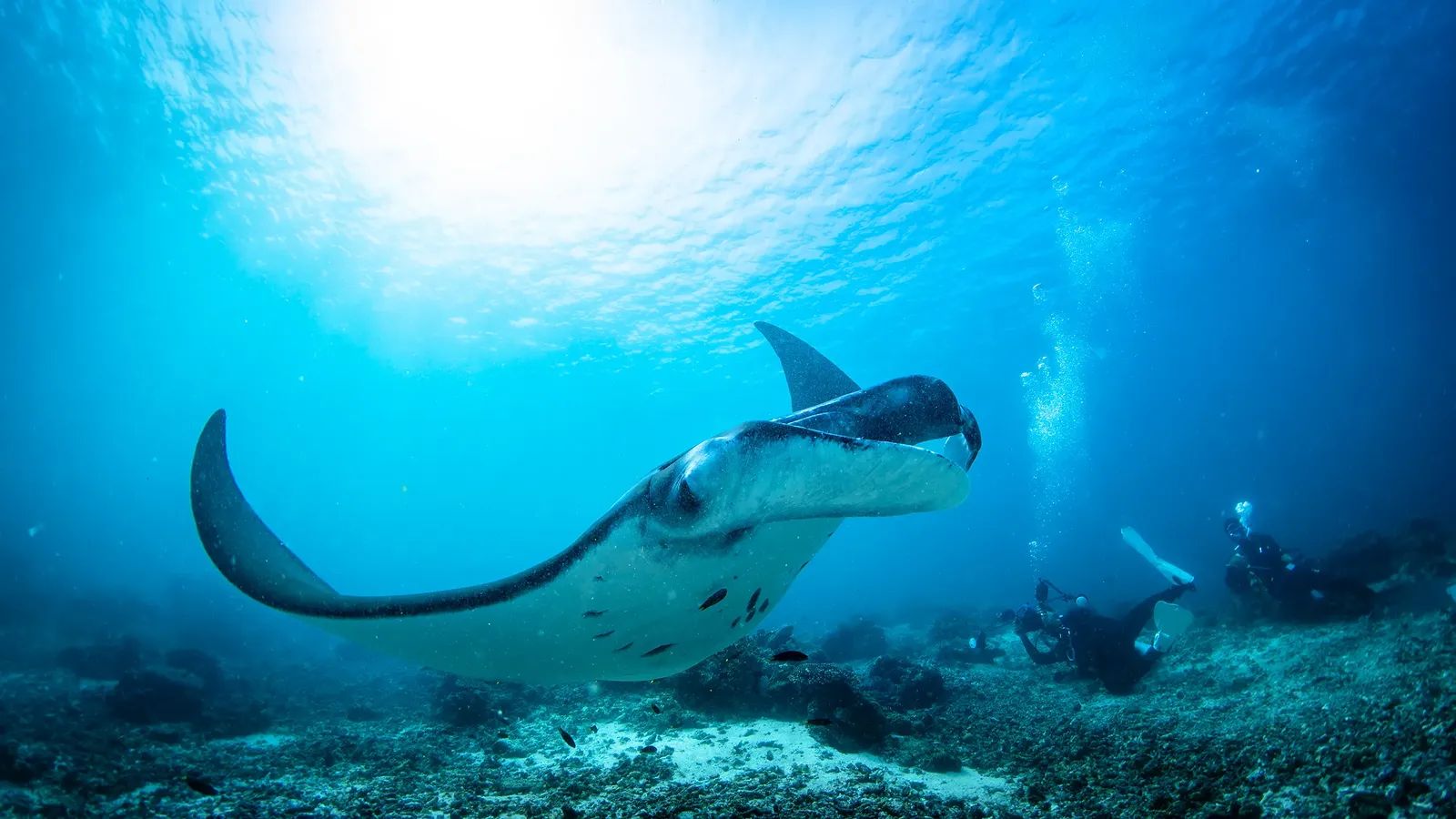
Manta ray diving Komodo National Park Indonesia liveaboard expedition underwater photography - Picture by Neptune Liveaboards
Managing Expectations
Manta ray encounters at cleaning stations are among the most reliable in wildlife diving, but reliable is not the same as guaranteed. Mantas read conditions — current strength, plankton density, water temperature — and move accordingly. A site full of mantas Monday may be empty Tuesday. Operators with strong local knowledge adjust site selection daily, and a good guide matters more than a good itinerary on paper.
Manta Point at Nusa Penida and the southern Komodo sites can be cold and surgy during the southern winter (July–September). Indian Ocean upwelling brings thermoclines that can drop water temperature several degrees within a few metres. A five-millimetre wetsuit is worth carrying for these windows at both destinations.
Blue Magic in Raja Ampat is current-driven and best suited to divers comfortable in moving water. If you're a beginner specifically targeting oceanic mantas, Manta Alley in Komodo or Magic Mountain in Misool offer more forgiving conditions for the same species.
Snorkellers at surface feeding sites frequently have the best encounters of any given day. When mantas are feeding on plankton at the waterline, a snorkeller positioned correctly sees more than a diver below. Don't treat surface access as a second-best option.
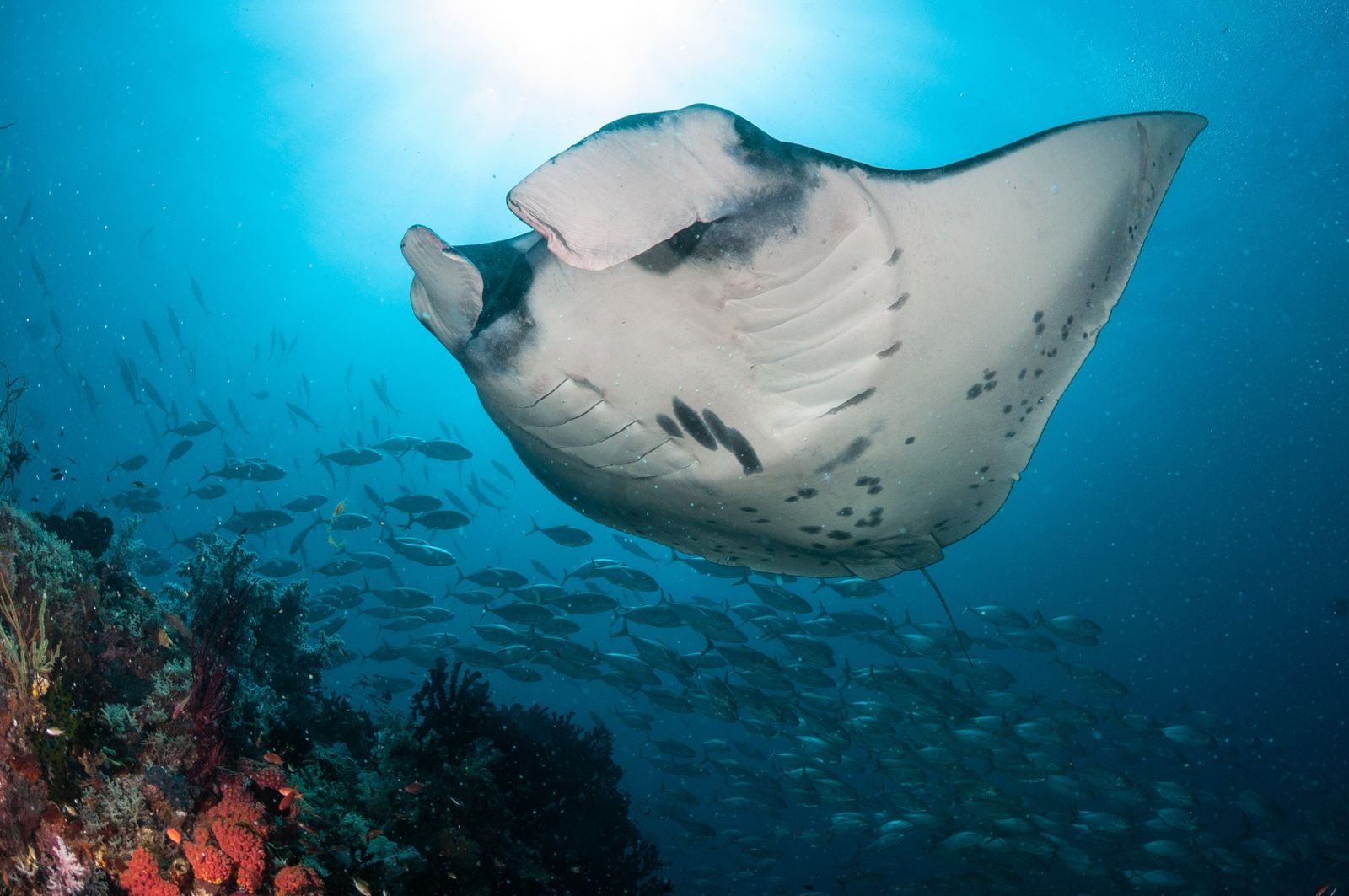
Manta ray diving Komodo National Park Indonesia liveaboard expedition underwater photography - Picture by Neptune Liveaboards
Frequently Asked Questions
How many manta rays will I see at Komodo's cleaning stations?
Operators consistently report three to eight individuals at a time under normal conditions, with larger aggregations during peak feeding periods. The MMF study documented significant daily variation between sites¹ — Manta Alley tends to produce the most consistent numbers due to its remoteness, while Karang Makassar can vary with boat traffic. At Manta Sandy in Raja Ampat, one to four individuals is typical; Blue Magic encounters are more variable and current-dependent.
Do I need dive insurance for liveaboard diving trips in Indonesia?
Yes. Dive insurance with medical evacuation coverage is mandatory under Indonesian law and non-negotiable for remote expedition diving. Standard travel insurance frequently excludes evacuation from remote areas — verify your policy explicitly covers Indonesia and includes remote-area extraction. Our liveaboard packing guide covers insurance and pre-trip preparation in detail.
Do I need Advanced Open Water to see manta rays?
No for most sites. Komodo's main cleaning stations, Manta Sandy in Raja Ampat, Sangalaki, and Nusa Penida are all accessible to Open Water divers. Blue Magic in Raja Ampat and Manta Alley in Komodo involve stronger currents and are better suited to Advanced Open Water or experienced Open Water divers with solid buoyancy. Check which sites your specific itinerary includes. Our beginner liveaboard guide covers certification requirements across Indonesian destinations.
What else can I combine with a manta ray trip?
Yes. Hammerhead sharks in the Banda Sea and sea turtles appear on the same itineraries as mantas across multiple destinations. Komodo combines naturally with Sumbawa (whale sharks, May–September); Raja Ampat combines with Triton Bay for whale sharks (October–April). For pairing ideas, our liveaboard extensions guide covers the options.
Is nitrox available on liveaboards in Indonesia?
Availability varies by vessel. Luxury and diving-focused boats typically include nitrox or offer it at a surcharge. At cleaning stations in the eight to fifteen metre range the benefit is limited — it becomes more relevant for the deeper reef and pelagic sites on the same itinerary. Our liveaboard category guide covers what each vessel tier includes.
Are manta rays related to stingrays? Are they dangerous?
Manta rays evolved from stingray ancestors but lost the venomous stinger through evolutionary adaptation⁸. Reef mantas (M. alfredi) have no caudal spine at all; oceanic mantas (M. birostris) retain a vestigial non-functional remnant⁸. They are filter feeders and entirely harmless. The no-touch protocol exists to protect the manta's mucus layer, which is part of its immune system — and because an animal with the highest brain-to-body mass ratio of any fish⁸ will simply leave a cleaning station if divers make it uncomfortable.
What are the responsible encounter rules for manta ray diving?
Keep a minimum three-metre distance from the body and further from the tail. Do not enter the cleaning station — hovering above the coral disrupts the cleaner fish and causes mantas to leave. Avoid flash photography directly into the eyes. Control your fin kicks above coral to prevent sediment disturbing the cleaning area. The same mantas return to the same sites for years; a site that gets regularly disrupted loses its residents permanently.
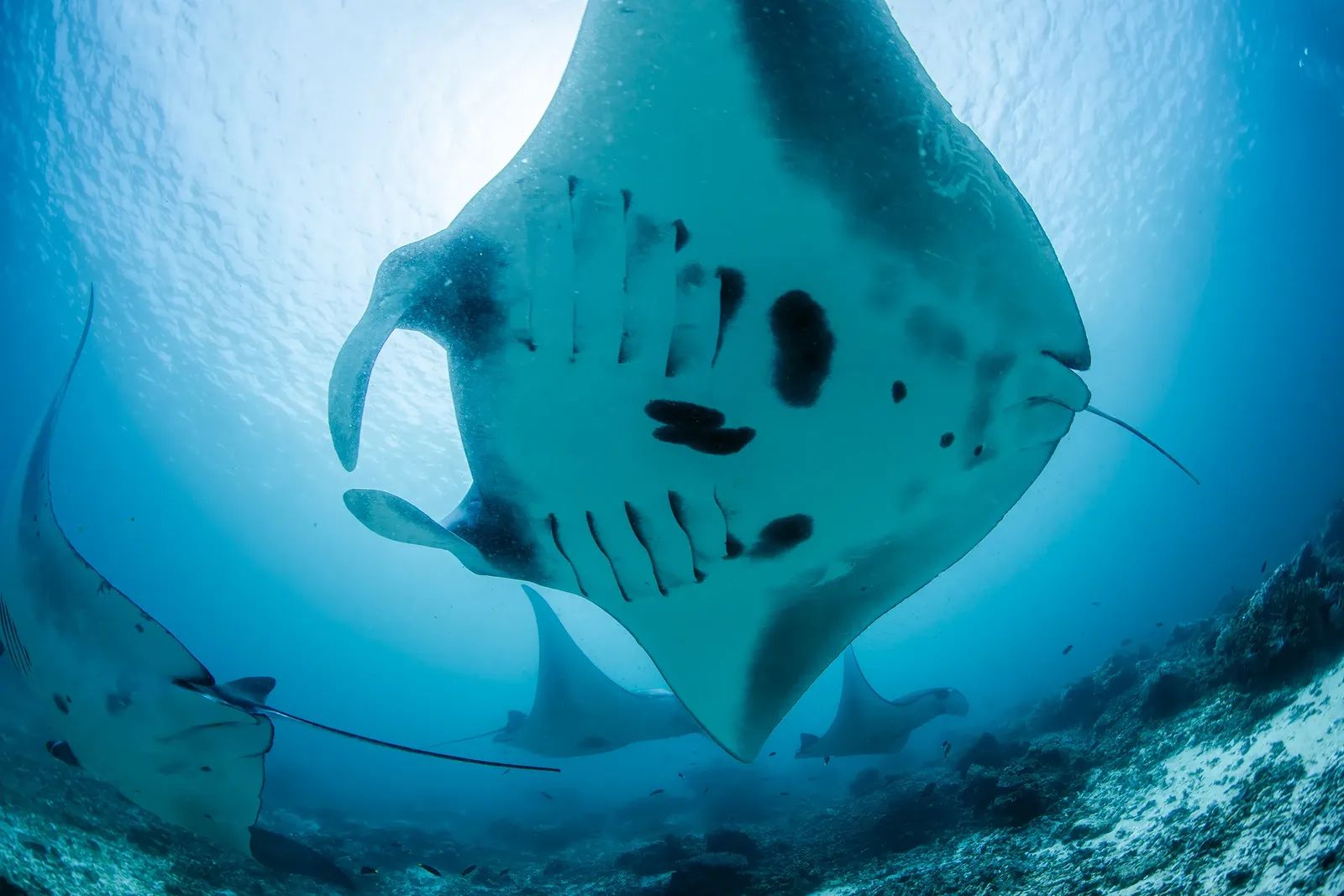
Giant manta ray close-up underwater photograph Raja Ampat diving Indonesia liveaboard destination - Picture by Dewi Nusantara
Plan Your Trip
Coralbound books manta ray liveaboards across all Indonesia destinations at the same price you'd pay booking direct, including the option of a complimentary hotel night. We know which Komodo itineraries cover Manta Alley as well as the central sites, which Raja Ampat vessels schedule Blue Magic dives at the right tidal window, and how Sangalaki fits into a Derawan Islands route. Reach us on WhatsApp or via the contact form — or read more about how we work before getting in touch.